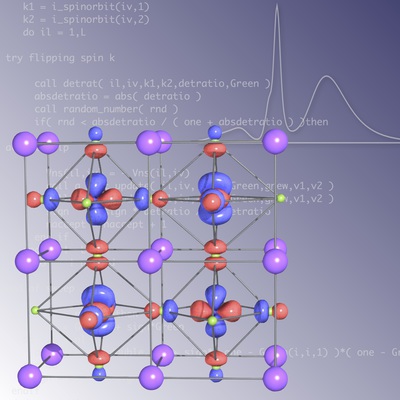
Solving the many-electron problem is the grand challenge of condensed-matter physics. Interacting electrons in fact lose their individuality forming emergent co-operative states, whose nature is difficult to unravel. Progress in understanding correlated states of matter requires the combination of several complementary approaches, theoretical and experimental. Only in this way one can pinpoint the microscopic mechanisms driving the co-operative phenomena characterizing strongly-correlated systems.
The goal of this year’s school is to provide students with an overview of modern many-body methods and their application to materials, with an outlook to the future of many-body simulations. The program will start with introducing the fundamentals: density-functional theory, the many-body problem and its complexity, emergent phenomena, the Hubbard and Kondo models and their physics. More advanced lectures will cover many-body methods: static and dynamical mean-field theories, cluster methods, DMRG, tensor networks, and machine learning. Additional lectures will cover more explorative approaches, such as variational methods suitable for quantum computers and many-body solvers exploiting artificial neural networks. The lectures will show how the approaches can be used to unravel the mechanism of paradigmatic emergent phenomena in materials: non-conventional superconductivity, Mott phases, orbital ordering, topological phases of matter, the quantum Hall effect, and quantum spin-liquid phenomena. The topics will be treated with a focus on explaining key experiments in a realistic setting and an outlook on questions of materials design. Dedicated experimental lectures will explain the complexity of crystal-growth, cover experimental methods for characterizing many-body phases as well as experimental equilibrium and out-of-equilibrium probes of many-body states.
Click on the lecture for the slides.
| Mon 21 Sept | Tue 22 Sept | Wed 23 Sept | Thu 24 Sept | Fri 25 Sept | |
|---|---|---|---|---|---|
| 09:00 | Welcome | Lanczos E. Koch |
Mean-Field Hubbard W. Metzner |
Light Control M. Mitrano |
Neural QStates A. Bohrdt |
| 10:30 | Coffee Break | ||||
| 11:00 | LDA+DMFT E. Pavarini |
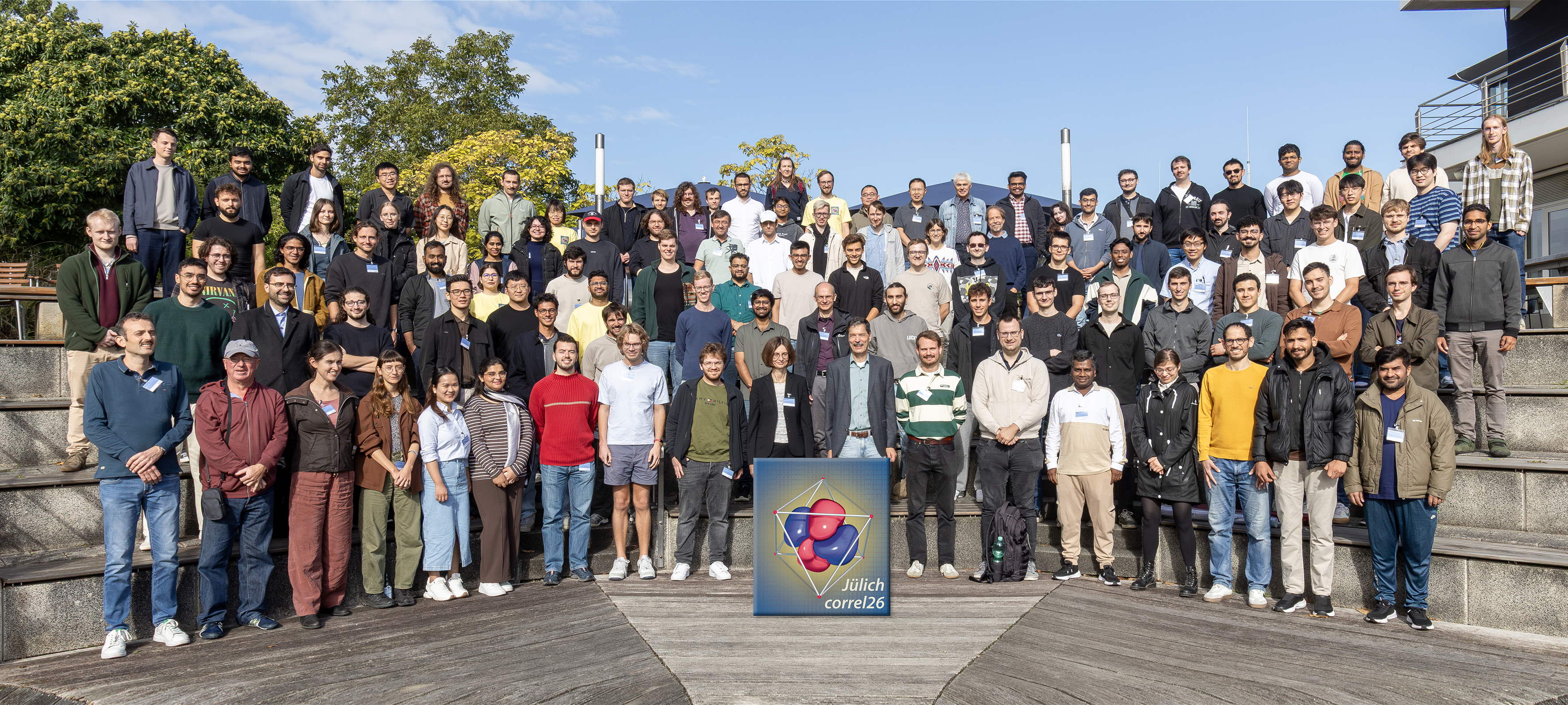
Photo | Ginzburg-Landau C. Timm |
RIXS M. Grüninger |
DMRG solvers U. Schollwöck |
| 12:30 | Lunch | ||||
| 14:00 | Constrained DFT X. Gonze |
Σ Functionals R. Eder |
Topological Phases C. Repellin |
Variational MC L. Tocchio |
Bus to Aachen |
| 15:30 | Coffee Break | ||||
| 16:00 | Phase Transitions A. Böhmer |
Quantum Computing B. Fauseweh |
Poster Session | Diagrammatic MC R. Rossi |
|
| 17:30 | Discussion | ||||
| 18:00 | Bus to Aachen | Poster Session Buffet |
Bus to Aachen | ||
| 20:30 | Bus to Aachen | ||||
Venue: The school will take place from 21-25 September 2026 at the Forschungszentrum Jülich, in the Lecture Hall of the Peter-Grünberg Institute, building 4.8, room 365.
Participation: The school is intended for advanced graduate or PhD students and postdocs in the field of electronic structure of materials.
Admission: Interested students should apply before May 31, 2026 through the registration form. Accepted applicants will be informed via e-mail two weeks after the deadline for applications.
Accommodation: Students can apply for financial support to cover accommodation costs. Participants supported by the school will be accommodated in the Aachen Youth Hostel. Funding for accommodations is limited.
ICAM Junior Travel Awards: Eligible candidates can apply for an ICAM Junior Travel Award. Funding is limited to about 10 students. For more information see the ICAM site and the registration form.
Transport: A shuttle bus will be operating in the mornings and evenings between the Youth Hostel in Aachen and the Forschungszentrum Jülich. The bus will leave in the morning from Aachen Jugendherberge. There will also be a shuttle from Jülich, from Stadthotel Jülich.
Other ways to reach the Forschungszentrum.
Hotels in Aachen and Jülich: Participants for whom no low-cost accommodation can be found or who wish to stay in a hotel may find hotels at these web-sites: Jülich and Aachen.
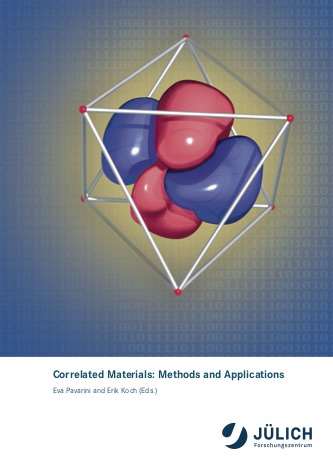
The lecture notes have been published as an OpenAccess book:
Eva Pavarini and Erik Koch (eds.)
Correlated Materials: Methods and Applications
Modeling and Simulation, Vol. 16
Verlag des Forschungszentrum Jülich, 2026
ISBN 978-3-95806-908-4 (Print), 978-3-95806-909-1 (E-Book)